Inaccessible in Reno

Reno decision on Prado Ranch: not accessible

Consideration of the Prado Ranch development in Lemmon Valley is scheduled for a meeting starting at 10AM on Wednesday, March 27 at the City Council Chambers.  Given the manifold problems associated with this development, it is telling that the City Council has scheduled it for a time when employed residents can’t be present.  This development will likely have a substantial negative impact on residents in terms of flooding, traffic, school overcrowding and safety in general.  The best practice of the City would be to have it considered in an evening meeting, or at least to have it scheduled for a “time certain” so that workers might plan to be absent from work in order to attend.

Meeting agenda 

Contact your council member

Reno City Council 3/13/19

Guest post by Pamela Galloway …

Who’s calling the shots around here?

Following are a few items of note gleaned from Wednesday’s Reno City Council meeting.

1. The “Public Comment” agenda item featured several citizens who discussed Lemmon Valley’s Swan Lake flooding problem. They came armed with photos. The water is rising and effluent is now everywhere, not contained to one part of the lake. The barriers are leaking. Citizen Danny Cleous — who lives near the lake and speaks regularly before the council and the commission — said that effluent is flowing everywhere now (versus being contained in one part of the lake) and he has been experiencing sickness for the last year, which he apparently attributes to this. People said they have had to put pets down because of the effluent. One photo depicted the back yard of the local elementary school, submerged in water. This entire matter is the subject of a lawsuit that goes to trial in June.

2. Some might recall that long ago Councilwoman Jenny Brekhus was calling for standing up a robust stormwater utility for City of Reno. (Reno would go it alone versus waiting for any regional effort.) Long before the election (flood ballot measure) Reno Director of Public Works John Flansberg analyzed the flood situation monetarily – river only – and determined that other municipalities would gain far more than the city of Reno, so the ballot measure was not a good deal for the city. Council members soured on the measure and several publicly voiced opposition to it. They talked of going it alone on stormwater problems. On Wednesday, a folksy middle-aged man from North Carolina gave a succinct presentation on Reno’s problems and what it would take to address them. He also works with New Orleans, LA, Philadelphia and other places. He analyzed Sparks, which he said had the most complex fee structure ever to address flood problems. Sparks charges itself some $13 monthly per residence, give or take. My sense is that this is “yes” – Reno is going to pursue this and set up its own stormwater utility, charging everyone to address all the ditches, creeks, flooding problems. In the end Brekhus commented quickly that of course the developers are all going to be paying for their own situations going forward. Currently Reno spends in a range of $1.8-$2.3 million yearly for stormwater problems. The expert said a few times, “Just call it $2 million” a year.

3. “Who’s calling the shots?” There was extensive testimony about the RTC overhaul of Midtown, Virginia Street, and some side streets. The head of RTC and others were being grilled, while business owners were quite concerned about outcomes – parking, landscaping, side streets. I gather RTC was perceived as making changes without the knowledge of the council. RTC seemed to be in a “well tell us what you want” mode. This concern seemed to be shared by the mayor and several council members. RTC is trying to create extra parking on side streets.

4. During the legislative updates the city’s liaison said that Ben Kieckhefer’s bill – studying fire issues – calls for the nearest unit(s) to respond to dispatches, regardless of jurisdiction and territory. In response to that, Brekhus said she wanted a fiscal analysis of this. (Critics say that Reno Fire Department fails to dispatch the closest fire engines, or delays in dispatching them. Other fire entities report ongoing difficulties dealing with Reno Fire Department, which is perceived as uncooperative. This has been going on for years. The criticism is that while another entity such as Truckee Meadows Fire Protection District or Sparks might have vehicles far closer to the scene, Reno does not engage automatic aid and summon the nearest help. I’m told this will also be the subject of an RGJ op-ed very soon.)

County Scandal 3/12/19 Edition

It looks like the deteriorating conditions are taking a sharp turn for the worse in Lemmon Valley.  Neighbors reported to the Washoe County Commission today the following developments.

DCIM100MEDIADJI_0006.JPG

There appears to be a portable unit pumping untreated effluent directly into Swan Lake.

DCIM100MEDIADJI_0005.JPG

Some of the levies around the wastewater plant are now submerged so that the  treatment basins are no longer isolated from Swan Lake.

One neighbor only has one dry spot on her 10-acre property.  Her car gets stuck in the mud on the way to the paved road.  She is seeing the worst flooding in recent years and the runoff season is just starting.

The elementary school is at the edge of the floodwaters.  Plastic nets have been erected as temporary fencing to keep the pupils from the contaminated water.

The road bed under Pompe Road now has ten steady leaks from one side to the other through the road bed.  These are new in the last few weeks and appear to be growing.  County Engineer Dwayne Smith has asserted that this leakage does not threaten the integrity of the road.  He has little credibility with the neighbors.

The Hesco barriers have ever increasing leaks as they deteriorate.

Not raised today by the speakers is that observation that this year is not an unusual year for storms or for precipitation.  The “new normal” for these residents appears to be deteriorating.

Rough Reception for Silver Hills Project

NV_CAB_031119_E

The Silver Hills development at Silver Knolls was introduced at the North Valleys Citizens Advisory Board last night.  It was met with unbridled derision by residents primarily from Lemmon Valley and Silver Knolls.  The plan includes building 1,872 homes on 780 acres west of the Stead Airport.  The developer wants changes to the Master Plan and zoning requirements to allow 2.4 homes per acre (average).  The current zoning requires 1 acre lots.

Public Comment included the following points; it was a full house

  • Silver Knolls and Red Rock residents are concerned about declining property values due to the high density development.
  • Area schools are already at capacity and traffic is already bad.  The Stead Sewer Plant expansion is only in the “study” phase.
  • A lot of time and effort went into the Character Management Plan.  We should not make exceptions casually.  Why have a plan if every development is an exception?
  • There are 15,000 residences approved but not built and 100,000 more that could be built following current zoning.  There is no need for higher densities.
  • Lemmon Valley residents reported that their situation is more dire with increased flood coverage and failing retention levies. In Lemmon Valley, parts of the sewage levy are now underwater.  The unpaved section of Deodar is impassible.
  • How about a fund from developer fees to solve the flooding?

There was open scorn for the County and City from the residents.

  • “Does the County Commission only exist to support corporate profits?”
  • A call for a moratorium on construction generated applause from the audience.
  • “Where is Bonnie Weber?  She has been responsible for a lot of the problem development in the North Valleys.”

The developer made the following points with their presentation.

  • Their design will be further changed, so this presentation is only preliminary.  They will come back with an updated design in a couple of months.
  • They have reduced the total residence count from 2,340 to 1,872.
  • They have limited the kinds of companies that could occupy the commercial area.
  • They have updated sewer and drainage to better protect Swan Lake.

The Board members raised the following questions and made the following points.

  • “How will the developer help to improve the limited law enforcement?” (Aquila)
  • “How will traffic be managed when traffic is already a problem?” (unidentified)
  • “Our infrastructure can’t handle this additional development.” (Aquila)
  • “Why have a Master Plan if the County is so willing to make exceptions?” (Aquila)
  • “I won’t be voting for any new development.” (Edwards)
  • “I want to ‘agendize’ a discussion about how we can implement a total building moratorium.” (Edwards)
  • “The CAB should have more control over their own agenda.  [It’s been curtailed by the County Commission.]  The CAB should be able to cover issues with RTC, NDOT, and other agencies. (Lake)

The traffic report done by Paul Solaegui was hotly contested.  Residents scoffed at the traffic report that was conducted Saturday at 8AM on July 2 during the holiday weekend.  It was pointed out that the same traffic engineer did a traffic study for the Prado North development on the day after New Years Day.  The new elementary school traffic is not accounted for.

Mr. Soleagui defended his work claiming the study was “statistically meaningful”.  The new elementary school will draw traffic only in the neighborhood, so it doesn’t need to be considered.  He is very experienced and follows a lot of RTC guidelines in his work.  He is instructed which intersections to consider.  He admitted that State and County standards permit traffic congestion that most residents would find objectionable.  The audience was not convinced.

There was no vote: this presentation is preliminary and only for information.  It will be submitted to the CAB again after it has been updated.

Commissioner Herman spoke thanking residents for attending and “defending their neighborhoods”.  She also spoke of a recent trip to Washington DC and how she has “something in the works”.

Developer handout: Silver_Hills_Handout_031119_0001_scw


Area Economy, Jobs, & Housing 3/7/19

The Reno Financial Advisory Board saw a presentation (national_regional economic outlook) on the national economy with a report on economic activity in the Reno and Sparks area.  Information on jobs and housing bear on development in the area.

My takeaways …

Eugenia Larmore (consultant) reported on the national economy.

  • The national economy is expected to slow down in 2019 but not to enter a recession.  Growth is expected to slow down from 2.7% in 2019 to 2.0% in 2020 (adjusted for inflation).
  • Expect existing home sales to fall 1.1% in 2019 and rise 4.0% in 2020.
  • Expect new home sales to rise 3.4% in 2019 and 9.2% in 2020.
  • Gaming revenue is down in Washoe County and Las Vegas, but meals and amenities (resort features) revenues are up.

Brian Bonnenfant (UNR Business School) reported on the Reno and Sparks area economy.

Housing Demand

  • Area employment peaked at 223,900 in 2007 falling to 189,100 in 2011, and rising to 241,167 in 2018.  The net increase over 11 years was 17,267 jobs.
  • Expect 9,000 new jobs to be created in 2019 for a total of 250,221.  This maintains the roughly 4% annual increase since 2012.
  • Home and apartment demand in 2018 were less than in 2016.
  • Only 327 existing homes sold in January 2019 as opposed to 570 sold in January 2018.  This is the lowest since February 2009.

Housing Supply

  • There are now 3,953 apartments under construction with another 7,418 approved.
  • New apartment construction in 2018 was 2,216.
  • New home sales were 1,572 in 2018.

Affordability

  • Affordability is the issue: $81,700 household income needed to afford the median existing home costing $367,000 (Q4 2018).  Median household income is $75,268.
  • Median home buyers are shopping for a townhouse or a condo.
  • New home sales in 2018 had median prices rising from $420,000 to $510,000 falling to $480,000 in January 2019.
  • Median existing-home price for homes sold in January 2019 was $360,000.
  • Average apartment rents dipped to $1,292 in Q4 2018 down from a peak of $1,319 in Q2 2018.

Miscellaneous

  • While the labor force is growing about 4% per year, school enrollment is flat since 2016.
  • Residents moving within Washoe County (50,000) are greater than the new residents moving from other areas (27,500) in 2018.

Labor and Employment

  • Manufacturing (mostly TRIC) showed the biggest increase in jobs: 3,183 (2017/2018).  Average manufacturing wages are $28.72/hour.
  • Manufacturing employment is expected to continue to grow the fastest in 2019 followed by construction.
  • Total employment breaks down in the following order: Leisure & Hospitality, Professional Services, Government, and Education.  Manufacturing ranks seventh.


My assessment of the information is that the real estate market is cooling entering 2019.

  1. Existing home sales turned down.
  2. Existing home prices are flat or down.
  3. Rents went down.
  4. New home prices are down.

It may just be a dip, but it may be time to pause development and absorb the many homes and apartments that are being built or are approved to be built.  This report does not support the argument that the area has a desperate need for new housing.  New condos or townhouses are likely to be the most popular.  TMRPA reports there are 15,000 new homes and apartments in the area which are approved but not yet built.

Lemmon Valley Warehouse not approved

The Reno Planning Commission failed to approve an application by Makita for a distribution warehouse and training center on Military Road.  This was to be a massive structure: 818,000 sqft on a 46 acre lot.  The location is quite close to the shore of Swan Lake, but was on a rise above the shore elevation.

Neighbors expressed the following concerns:

  • The current flooding in Lemmon Valley may be worse than it was in 2017.  The flooding needs to be addressed before more development is approved.
  • There should be a moratorium on new construction until the flooding is addressed.
  • Lemmon Drive is closed due to flooding.  The only access to the neighborhoods is Military Road.  Construction would constrict traffic further.
  • Pompe Road has water flowing through the base road bed.  It is at risk of washing out.
  • Water is flowing under the existing Hesco barriers.
  • Some detention ponds in the area are empty despite the bad flooding.
  • The detention ponds don’t work.
  • The toxic water is now close to the neighborhood school.
  • It’s been 2-1/2 years that the floods have been present.  The neighbors should be thanking the City for solving the problem by now; not reminding them of the crisis.
  • The warehouse lot isn’t level.  Where will the sediment flow after all the grading is done?

One neighbor suggested that detention ponds be dug close to Swan Lake to reduce flooding.  He further suggested that the developer in this case could do some of it since the property borders on Swan Lake.

The developer’s engineer asserted that the site will incorporate over a million gallons worth of detention pond volume.  This will more than compensate for the increased run-off due to the paving.  The developer’s hydrologist admitted that the detention ponds need regular “maintenance” to be effective.  This mainly involves digging out accumulated silt so that the pores in the base soil can drain the water.  He said that the maintenance would be a good idea after every major storm.  That sounds impractical.

The commissioners made the following points.

  • We need a comprehensive solution to the flooding in the area involving, Reno, Sparks, and Washoe County.  This ad-hoc approach is insufficient. (Marshall)
  • We’re trying to solve the problem by applying conditions to the individual developments rather than tackle it on a larger scale.
  • This tall warehouse is on a rise so that it would be visually prominent even with landscaping. (Johnson)

The vote was 3-3 which means that the project was not approved.

For: Weiske, Gower, Olivas

Against: Marshall, Johnson, Hawkins

Griffith recused herself since her family company is working on this project


Daybreak Redux, Ward 3 NAB 3/5/19


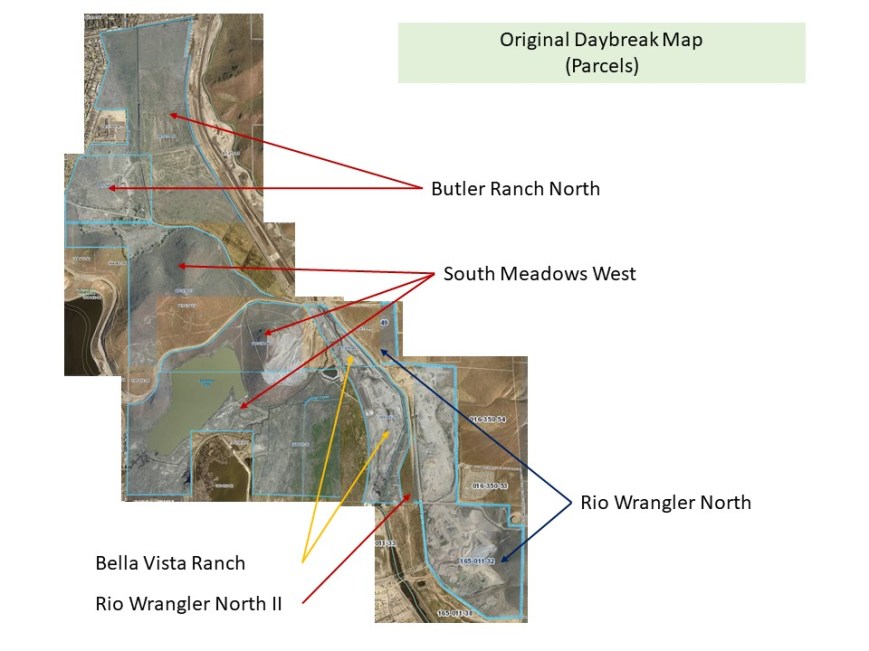
Rio_Wrangler-North-II_Parcel-Map_01C

Not content with just a lawsuit against Reno for denying the original Daybreak project, the developers are making another attempt to get the project approved piecemeal.  Last night, the developer presented two requests for master plan amendments (and re-zoning) and presented a third project for tentative map approval.  The new re-zoning requests are for projects called South Meadows West and Rio Wrangler North II.  The third project was the Butler Ranch North development which has received the zoning amendment and now seeks tentative map approval.  The tentative map will provide minimal detail since it defines 9 “villages”.  The developer plans to sell the village parcels to developers who will complete the plan and apply for tentative maps individually.  The Rio Wrangler North development is also part of the Daybreak project.  It is located east of the Rio Wrangler North II project.

The Reno Neighborhood Advisory Board (NAB) meeting was sparsely attended.  One neighbor expressed concerns about traffic, school overcrowding, flooding, and Mercury contamination.  She appeared to speak for other neighbors present.

The developer’s spokesman (from Wood Rogers) admitted that the individual developments were components of the original Daybreak project.  The South Meadows West and Rio Wrangler North form the southern part of the original Daybreak proposal north of the Damonte Ranch area.  The Rio Wrangler North II development fits between the South Meadows West and Rio Wrangler North developments.  The massive Daybreak project lies on the west side of Veterans Parkway between South Meadows Parkway and Mira Loma Drive.  It is not clear whether there were any changes between the original plan and the sum of the new subordinate plans.  One key point was that the Butler Ranch North project can’t be built without the Rio Wrangler North being approved.

The NAB has a limited role to inform residents of plans in the Ward and also to convey feedback to the Planning Commission regarding public input.  The Planning Commission will hear the Butler Ranch North project on either April 3 or April 17.  The South Meadows West and Rio Wrangler North II projects will go to the Planning Commission on April 17.  Residents can express themselves by attending these meetings.  Alternately, they can contact their Planning Commissioner Peter Gower.  The NAB and the developer are requesting feedback with their project review form.  This will be used to inform the developer and the Planning Commission, but may not be as effective as contacting Peter Gower or other planning commissioners directly.

Washoe Tidbits 2/22/19

Truckee Meadows Fire Protection District Meeting 2/19/19 (Notes by Tom Daly)

These are only selected highlights.  Emphasis added by Wolgast.

Sierra County, CA automatic aid agreement – Chief Moore has finalized the agreement as to the limited service area (not the whole county), TM units to respond to fires and the fee to be charged to Sierra County.  The agreement will now be reviewed by the District Attorney and will likely be presented to the Board for final approval in March.  This agreement is much more favorable to TMFPD than the current version.

Gerlach – A report from the District’s consultant Mike Brown will be presented in March on options to provide fire protection to this small community in northern Washoe County (not within the TMFPD).  Chief Moore indicated he is ready to take over operations (from the County) but the financials remain to be resolved as this is a County, not a TMFPD, responsibility.  The cost is about $1 million per year for staffing, supplies, equipment and station operational costs and some needed station modifications

Fleet additions –  Two new 3,000 gallon water tenders are here and being outfitted with radios and related equipment. They should be in service in early March at the latest, with one going to TM#33 Foothill.  The Board approved Chief Moore’s request for $80K for equipment (hose, ladders, tools, radios, etc. ) for the two new Type 1 structure engines due to be delivered in May.  The boards also approved $93K for two new command vehicles, typically for the two Operations Battalion Fire Chiefs.

Automatic aid – For CY2018 automatic aid from TMFPD to Sparks was at a rate of 20 times for each one time Sparks responded to TMFPD.  This imbalance is due to the poor distribution of fire resources by Sparks.  Every time a TM engine is servicing Sparks, it is not available to service taxpayers of the TMFPD.  TMFPD also responds more to Reno than Reno responds to TM.  The automatic vehicle locator (AVL) technology is in place and working for TMFPD (WCSO dispatch) and Sparks dispatch but not in Reno.  Reno refuses to provide the data base to ensure the ‘closest engine’ responds (to fires) per the existing automatic aid agreement.

Stonegate – This City development underway cannot be served by Reno Fire as they lack the staff to do so, even with the developer providing a temporary station (house) and future station (land and building but no equipment or vehicles).  As such, TMFPD will have to serve this community without getting any tax revenue or reimbursement as they TM be the ‘closest unit’ under the current automatic aid agreement.

Truckee Meadows Water Authority Meeting Highlights 2/20/19 (Bill Maggiora)

Bill Hauck discussed the current (as of 19 Feb 2019) snowpack.

  • He said that it was higher than normal by 160 to 175 percent of normal, depending on the area, for 19 February.  This was still way below what we had in 2017.
  • Bill also discussed water storage and Truckee River flow, which they wanted to keep below 5,000 Cubic Feet per Second.
  • Apparently, the available water storage facilities are pretty full and they may need to start releasing water to avoid flooding when the snow melts.
  • Bill said that we had a three-year supply of water stored in Lake Tahoe now.


—> Don’t forget to check out the In the Media page for recent articles and opinions regarding area development.


NRS Fails Homeowners

As homeowners and property owners, we’ve seen the irresponsible decisions made by the Washoe County Commission and the Reno City Council.  These are decisions that detract from the appeal of the area and some of them affect our properties directly.

There is a pretty straightforward process to appeal a decision of the Reno Planning Commission or the Washoe County Planning Commission to the City Council or the County Commission.  But, what do you do when the City or County decide against your interests?  The next step is to go to court with a “petition for judicial review”.  You are requesting a district court judge to review the decision by the City or County.  The statute (NRS 278.3195.4) is written so that:

If you appeal the Planning Commission decision AND you appeal the County Commission (City Council) decision, then you can petition for judicial review.  OK.

But,

If the Planning Commission decides in your favor so that you don’t appeal, but the County Commission reverses that decision, then you may not petition for judicial review.  This makes no sense.  No one would appeal a decision that went in their favor.

The law needs to change to grant standing whether the homeowner appealed the Planning Commission decision or not.  The homeowner needs to have “participated” at the Planning Commission level which could include speaking during public comment.  The avenues available to citizens to change the law are to submit a  Bill Draft Request (BDR) or to amend an existing bill that is in process.  February is late in the cycle to submit a BDR and each legislator only has one “late” BDR that they can submit.  These are prized and there are usually competing interests for the last one.  I drafted a BDR with some legal help and went to the following State Assembly members.

  • Sarah Peters, District 24
  • Lisa Krasner, District 26
  • Alexis Hansen, District 32
  • Skip Daily, District 31

None were willing to sponsor my BDR as their late BDR.

A fellow WRAP activist tried another approach.  He identified a bill that was being considered by the assembly that impacted part of NRS 278.  He contacted one of the authors of AB5, but was told that this bill was not likely to pass and might be withdrawn.  It would not be a good vehicle to implement our change.  I contacted Assemblyman Howard Watts (District 15) by phone and e-mail.  He had a BDR affecting NRS 278, but he did not get back to me before the deadline the next day (2/12/19).

Now what?!  My experience with citizen-driven legislation has not been encouraging.  If I’d been able to start earlier, I would have had a better chance.  But, the issue only became clear on January 17.  There’s always 2021 to try it again.  I’m concerned that there may be a substantial number of development cases which will be tilted against the homeowners in the mean time.  There is also the opportunity to appeal through the courts.  This case could go to the Nevada Supreme Court on the basis of “due process”.  The NRS denies “equal protection under the law” to homeowners.  An appeal will likely be expensive, and the outcome would be unpredictable.  Lastly, there is some interest in revising NRS 278 more broadly.  It is described as a series of patches upon patches such that it is neither consistent nor logical.  At this point, some BDR’s are submitted to address the shortcomings of previous BDR’s.  It is probably time for a re-write that is consistent with best practices.  This has recently been done by several states.

Official Text: (Note: “governing body” would be City Council or County Commission)

NRS 278.3195
      4.  Any person who:
      (a) Has appealed a decision to the governing body in accordance with an ordinance adopted pursuant to subsection 1; and
      (b) Is aggrieved by the decision of the governing body,
may appeal that decision to the district court of the proper county by filing a petition for judicial review within 25 days after the date of filing of notice of the decision with the clerk or secretary of the governing body, as set forth in NRS 278.0235.
LINKS:

Subsidizing Developers 2019

We’re seeing it North and South in the Truckee Meadows.

The Washoe County Commissioners are requesting a $50M bond to increase the sewer capacity in the Pleasant Valley area.  Some of this cost would go to improving an existing sewer plant and to upgrade the existing sewer line.  Some will go to expanding the capacity.  Presumably, the extra capacity would be intended to support the dreaded Sierra Reflections project in Pleasant Valley.  It would bring suburban development to the rural area.  It is a zombie project approved in 2006 and repeatedly extended outside public view.  A detailed account of the $50M proposal has been requested, but not provided by the County.  The proponents claim that the bond will be paid back by developer fees when they start their projects and STMWRF rate payers.

The Reno City Council is considering a $56M bond to provide infrastructure to support the far-flung Stonegate Development at the foot of Peavine Mountain toward Cold Springs.  The developer would like to see funds from this bond available in June.  Proponents of the bond, again claim that the bond costs will be offset from fees paid for by the developer.

Both proposals ask the City and County taxpayers to bear the costs of development at the beginning.  Both proposals have limited recourse if the developer does not complete the projects or if the housing market turns down and the developments are abandoned.  Development is like high-stakes gambling.  The developer may win big or may bust dramatically.  The taxpayers are being asked to front the chips.

Both Sierra Reflections and Stonegate are poorly planned projects that will negatively impact area residents.  Both are only possible due to the favoritism paid to developers by the County Commission and the City Council.  Issues of traffic, area compatibility, flooding, school capacity, and emergency services are not credibly addressed.  The taxpayers shouldn’t be subsidizing developments that despoil their neighborhoods.  This is adding insult to injury to enrich the developers.  Express your opinion to your City Council member, County Commissioner, or mayor.

Washoe County Commissioners

Reno City Council Members