Lemmon Valley Warehouse not approved

The Reno Planning Commission failed to approve an application by Makita for a distribution warehouse and training center on Military Road.  This was to be a massive structure: 818,000 sqft on a 46 acre lot.  The location is quite close to the shore of Swan Lake, but was on a rise above the shore elevation.

Neighbors expressed the following concerns:

  • The current flooding in Lemmon Valley may be worse than it was in 2017.  The flooding needs to be addressed before more development is approved.
  • There should be a moratorium on new construction until the flooding is addressed.
  • Lemmon Drive is closed due to flooding.  The only access to the neighborhoods is Military Road.  Construction would constrict traffic further.
  • Pompe Road has water flowing through the base road bed.  It is at risk of washing out.
  • Water is flowing under the existing Hesco barriers.
  • Some detention ponds in the area are empty despite the bad flooding.
  • The detention ponds don’t work.
  • The toxic water is now close to the neighborhood school.
  • It’s been 2-1/2 years that the floods have been present.  The neighbors should be thanking the City for solving the problem by now; not reminding them of the crisis.
  • The warehouse lot isn’t level.  Where will the sediment flow after all the grading is done?

One neighbor suggested that detention ponds be dug close to Swan Lake to reduce flooding.  He further suggested that the developer in this case could do some of it since the property borders on Swan Lake.

The developer’s engineer asserted that the site will incorporate over a million gallons worth of detention pond volume.  This will more than compensate for the increased run-off due to the paving.  The developer’s hydrologist admitted that the detention ponds need regular “maintenance” to be effective.  This mainly involves digging out accumulated silt so that the pores in the base soil can drain the water.  He said that the maintenance would be a good idea after every major storm.  That sounds impractical.

The commissioners made the following points.

  • We need a comprehensive solution to the flooding in the area involving, Reno, Sparks, and Washoe County.  This ad-hoc approach is insufficient. (Marshall)
  • We’re trying to solve the problem by applying conditions to the individual developments rather than tackle it on a larger scale.
  • This tall warehouse is on a rise so that it would be visually prominent even with landscaping. (Johnson)

The vote was 3-3 which means that the project was not approved.

For: Weiske, Gower, Olivas

Against: Marshall, Johnson, Hawkins

Griffith recused herself since her family company is working on this project


Daybreak Redux, Ward 3 NAB 3/5/19


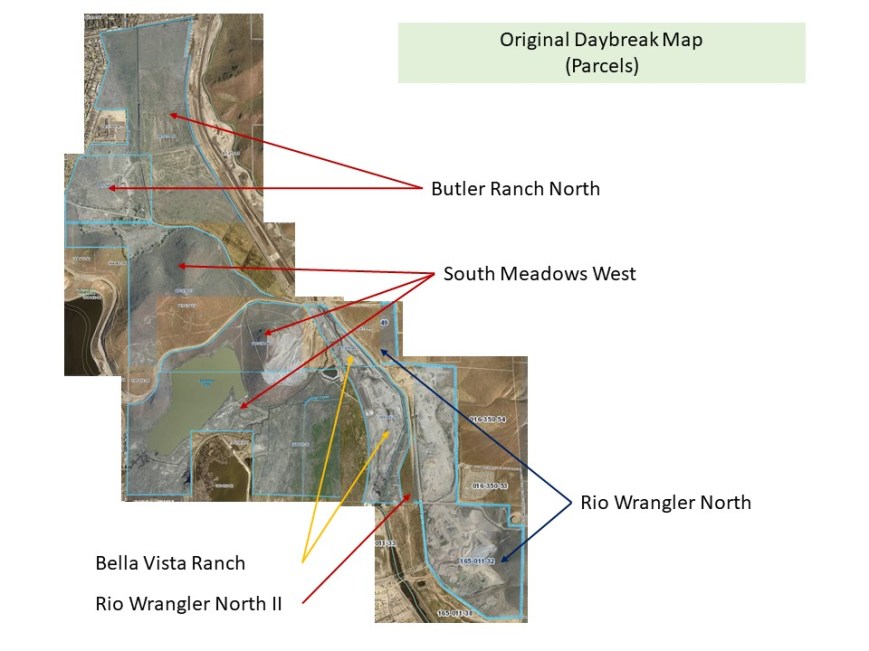
Rio_Wrangler-North-II_Parcel-Map_01C

Not content with just a lawsuit against Reno for denying the original Daybreak project, the developers are making another attempt to get the project approved piecemeal.  Last night, the developer presented two requests for master plan amendments (and re-zoning) and presented a third project for tentative map approval.  The new re-zoning requests are for projects called South Meadows West and Rio Wrangler North II.  The third project was the Butler Ranch North development which has received the zoning amendment and now seeks tentative map approval.  The tentative map will provide minimal detail since it defines 9 “villages”.  The developer plans to sell the village parcels to developers who will complete the plan and apply for tentative maps individually.  The Rio Wrangler North development is also part of the Daybreak project.  It is located east of the Rio Wrangler North II project.

The Reno Neighborhood Advisory Board (NAB) meeting was sparsely attended.  One neighbor expressed concerns about traffic, school overcrowding, flooding, and Mercury contamination.  She appeared to speak for other neighbors present.

The developer’s spokesman (from Wood Rogers) admitted that the individual developments were components of the original Daybreak project.  The South Meadows West and Rio Wrangler North form the southern part of the original Daybreak proposal north of the Damonte Ranch area.  The Rio Wrangler North II development fits between the South Meadows West and Rio Wrangler North developments.  The massive Daybreak project lies on the west side of Veterans Parkway between South Meadows Parkway and Mira Loma Drive.  It is not clear whether there were any changes between the original plan and the sum of the new subordinate plans.  One key point was that the Butler Ranch North project can’t be built without the Rio Wrangler North being approved.

The NAB has a limited role to inform residents of plans in the Ward and also to convey feedback to the Planning Commission regarding public input.  The Planning Commission will hear the Butler Ranch North project on either April 3 or April 17.  The South Meadows West and Rio Wrangler North II projects will go to the Planning Commission on April 17.  Residents can express themselves by attending these meetings.  Alternately, they can contact their Planning Commissioner Peter Gower.  The NAB and the developer are requesting feedback with their project review form.  This will be used to inform the developer and the Planning Commission, but may not be as effective as contacting Peter Gower or other planning commissioners directly.

NRS Fails Homeowners

As homeowners and property owners, we’ve seen the irresponsible decisions made by the Washoe County Commission and the Reno City Council.  These are decisions that detract from the appeal of the area and some of them affect our properties directly.

There is a pretty straightforward process to appeal a decision of the Reno Planning Commission or the Washoe County Planning Commission to the City Council or the County Commission.  But, what do you do when the City or County decide against your interests?  The next step is to go to court with a “petition for judicial review”.  You are requesting a district court judge to review the decision by the City or County.  The statute (NRS 278.3195.4) is written so that:

If you appeal the Planning Commission decision AND you appeal the County Commission (City Council) decision, then you can petition for judicial review.  OK.

But,

If the Planning Commission decides in your favor so that you don’t appeal, but the County Commission reverses that decision, then you may not petition for judicial review.  This makes no sense.  No one would appeal a decision that went in their favor.

The law needs to change to grant standing whether the homeowner appealed the Planning Commission decision or not.  The homeowner needs to have “participated” at the Planning Commission level which could include speaking during public comment.  The avenues available to citizens to change the law are to submit a  Bill Draft Request (BDR) or to amend an existing bill that is in process.  February is late in the cycle to submit a BDR and each legislator only has one “late” BDR that they can submit.  These are prized and there are usually competing interests for the last one.  I drafted a BDR with some legal help and went to the following State Assembly members.

  • Sarah Peters, District 24
  • Lisa Krasner, District 26
  • Alexis Hansen, District 32
  • Skip Daily, District 31

None were willing to sponsor my BDR as their late BDR.

A fellow WRAP activist tried another approach.  He identified a bill that was being considered by the assembly that impacted part of NRS 278.  He contacted one of the authors of AB5, but was told that this bill was not likely to pass and might be withdrawn.  It would not be a good vehicle to implement our change.  I contacted Assemblyman Howard Watts (District 15) by phone and e-mail.  He had a BDR affecting NRS 278, but he did not get back to me before the deadline the next day (2/12/19).

Now what?!  My experience with citizen-driven legislation has not been encouraging.  If I’d been able to start earlier, I would have had a better chance.  But, the issue only became clear on January 17.  There’s always 2021 to try it again.  I’m concerned that there may be a substantial number of development cases which will be tilted against the homeowners in the mean time.  There is also the opportunity to appeal through the courts.  This case could go to the Nevada Supreme Court on the basis of “due process”.  The NRS denies “equal protection under the law” to homeowners.  An appeal will likely be expensive, and the outcome would be unpredictable.  Lastly, there is some interest in revising NRS 278 more broadly.  It is described as a series of patches upon patches such that it is neither consistent nor logical.  At this point, some BDR’s are submitted to address the shortcomings of previous BDR’s.  It is probably time for a re-write that is consistent with best practices.  This has recently been done by several states.

Official Text: (Note: “governing body” would be City Council or County Commission)

NRS 278.3195
      4.  Any person who:
      (a) Has appealed a decision to the governing body in accordance with an ordinance adopted pursuant to subsection 1; and
      (b) Is aggrieved by the decision of the governing body,
may appeal that decision to the district court of the proper county by filing a petition for judicial review within 25 days after the date of filing of notice of the decision with the clerk or secretary of the governing body, as set forth in NRS 278.0235.
LINKS:

Subsidizing Developers 2019

We’re seeing it North and South in the Truckee Meadows.

The Washoe County Commissioners are requesting a $50M bond to increase the sewer capacity in the Pleasant Valley area.  Some of this cost would go to improving an existing sewer plant and to upgrade the existing sewer line.  Some will go to expanding the capacity.  Presumably, the extra capacity would be intended to support the dreaded Sierra Reflections project in Pleasant Valley.  It would bring suburban development to the rural area.  It is a zombie project approved in 2006 and repeatedly extended outside public view.  A detailed account of the $50M proposal has been requested, but not provided by the County.  The proponents claim that the bond will be paid back by developer fees when they start their projects and STMWRF rate payers.

The Reno City Council is considering a $56M bond to provide infrastructure to support the far-flung Stonegate Development at the foot of Peavine Mountain toward Cold Springs.  The developer would like to see funds from this bond available in June.  Proponents of the bond, again claim that the bond costs will be offset from fees paid for by the developer.

Both proposals ask the City and County taxpayers to bear the costs of development at the beginning.  Both proposals have limited recourse if the developer does not complete the projects or if the housing market turns down and the developments are abandoned.  Development is like high-stakes gambling.  The developer may win big or may bust dramatically.  The taxpayers are being asked to front the chips.

Both Sierra Reflections and Stonegate are poorly planned projects that will negatively impact area residents.  Both are only possible due to the favoritism paid to developers by the County Commission and the City Council.  Issues of traffic, area compatibility, flooding, school capacity, and emergency services are not credibly addressed.  The taxpayers shouldn’t be subsidizing developments that despoil their neighborhoods.  This is adding insult to injury to enrich the developers.  Express your opinion to your City Council member, County Commissioner, or mayor.

Washoe County Commissioners

Reno City Council Members

E Pluribus Unum

Of 144 applicants, Devon Reese was appointed to the Reno City Council to fill the remainder of David Bobzien’s term.  The City Council decided on appointing a replacement rather than holding an election for this seat.  Detailed report here.

Wednesday, February 13

The list of applicants was first reduced to 139 when 5 of them did not meet the residency requirements.  Each council member made a list of their 5 favorite candidates.  These were tallied.

Appointment_vote-tally_021319

The top four on this list were selected to participate in an open forum.

Devon Reese, lawyer, worked on labor cases with Reno police officers.

Britton Griffith, manager in the family’s civil engineering firm

Nathan Dupree, Pastor at the Living Stones Church, involved with homelessness

Krystal Minera, bakery owner, manages two radio stations, youngest at 28

Thursday, February 14

There was a forum with the four candidates in the council chambers.  All candidates were asked the same questions selected from a list submitted by residents.

None of the candidates could give a compelling reason as to why they were “running” and why voters should support them.  All wanted to convince the audience that they were “nice people” and advocated for more love and compassion in Reno.

Selected points made by the candidates: 

Nathan Dupree:

  • The mental illness problem is growing in Reno.
  • We need to do more to address public safety including Fire Dept. and Police Dept. issues.
  • He has seen discrimination: you have to truly want to diversify to be able to do it.

Britton Griffith:

  • We need a safe and vibrant downtown.
  • We need more ‘attainable’ housing for people who are working.
  • Growth should occur in areas with supporting infrastructure consistent with the master plan.
  • The at-large council member should make a determined effort to reach out to constituents.
  • The parking codes should be changed to make better use of the available spaces.

Krystal Minera:

  • We need to be doing more to protect victims in the workplace and also protecting victims of domestic violence.
  • We need ‘smart growth’ where there is supporting infrastructure.
  • We should do more to encourage home ownership.
  • We need more emphasis on health services for police and firefighters.
  • She wants to see more of the University in the downtown.

Devon Reese:

  • Reno has had a lot of success paying down its debt and supporting the housing boom.
  • He likes the Re-leaf Program to plant street trees.
  • He wants to see some kind of Community Center in the North Valleys.
  • Reno should be building all types of housing.

Friday, February 15, 2:00 – 7:00 PM

The candidates were sequestered in a conference room until they were summoned to chambers.  Here are a few of their responses to questions posed by the council members.

  • Devon Reese told Councilwoman Brekhus that he could serve effectively on the council after having a lot of experience supporting the Reno police union.
  • Krystal Minera could not describe to Councilwoman Brekhus  the differences between the role of the city manager and the city council members.
  • Britton Griffith said the most difficult part of serving on the Reno Planning Commission was to consider the flooding in the North Valleys because the impact was so personal.
  • All the candidates approved of police wearing body cameras responding to a question from Councilman Delgado.
  • Councilwoman Jardon asked all the candidates if they had ever voted for a candidate from the opposing party.  None gave a satisfactory answer.
  • In response to a question about sustainability, Griffith said she had campaigned against the use of plastic straws in some downtown restaurants.

Following brief deliberations, the council voted unanimously to appoint Devon Reese to the vacant position.


Spanish Springs Area Plan Vindicated

The Washoe County Planning Commission unanimously denied a re-zoning request made for the development of Upland Estates (2/5/19).  This is 46.3 acres of undeveloped property on the east side of the Pyramid Highway.  The developer wants to change the zoning from commercial to suburban-residential allowing for the construction of 129 homes.

The principal concern of the commissioners was the violation of the Spanish Springs Area Plan and the lack of commercial development convenient to this neighborhood.  This is envisioned to be neighborhood commercial with such establishments as a dry cleaner, a beauty salon, or an eatery.  The commissioners shared concerns that the public expressed for traffic management and sewer capacity as well.

The staff report indicated that increased traffic and sewer load would result with the change to residential zoning.  This was countered by the developer with reports showing the opposite, but these reports were not credible.

Upland Estates Staff Report

Rio Wrangler Area Re-zoning Denied.

Thanks to Pamela Galloway for this guest post.

Reno Planning Commission denies dense development north of Rio Wrangler, east of Bella Vista

Following testimony from Southeast Truckee Meadows residents opposing the rezoning of some 189 acres of aggregate pit east of the Bella Vista subdivision, the Reno Planning Commission Wednesday night voted 5-2 to deny an upzoning request.  It would have allowed for two to eight homes per acre on the hillside stretching from the Rio Wrangler Parkway area north past Steamboat Parkway.  The old Mira Loma Road was used to describe the location, an area that has served as an aggregate pit for many years.  (This is on hillside lands parallel to Veteran’s Parkway between Rio Wrangler and South Meadows parkways, and even to the north of South Meadows Parkway.)

Developer 

Developers’ representative Andy Durling of Wood Rodgers engineering consultants testified they wanted six homes per acre of single family residence (up from one resident per 2.5 acres now along the eastern edge of the meadows.)  It is not in a flood plain, he said, and while no actual development plan exists yet, the next step would be to create a subdivision.  Technically, they can ask for two to eight units, he said.  This land is the eastern portion of the former massive Daybreak development which was rejected recently by the Reno City Council. The Daybreak/Butler Ranch lands have become submerged under many feet of water in serious floods.  So now the developers have returned with a request only for the eastern portion, which is elevated from the Steamboat Creek and presumably away from these flood waters.

Citizens

Long-time area resident Judy Covert, the first in a string of citizens opposing, said this amounts to about 1,090 homes on approximately 150 acres, or 7.5 units per acre.  She asked that this be denied until Regional Transportation Commission (RTC) completes a study of transportation concerns in the entire SETM area.  “Don’t approve any more development until this study is done.”

A wild horse advocate, she and others testified that some 125 horses have been using this area to access Steamboat Creek for generations.  One wild horse proponent said different provisions would have to be made to ensure these horses get water.

Architect Jim Lewis said it was “insane” to rezone lands “before you figure out the impacts”.  Lewis said if there is a faulty road system, it is difficult to repair after the fact.  Mistakes were made around Damonte High School with roads, including the width of Rio Wrangler itself.

Opponent Jennifer Spade said 15,000-square-foot-lots would be preferable.  She asked where the studies of regional impacts are. “To address traffic after density is backwards.  Already it is getting difficult to travel in landlocked areas. When The Loop, the new DMV, and approved but unbuilt developments come on line it is going to become difficult to access Steamboat Creek, she said.

(Note:  Among the numerous developments yet to come on line are Caramella Ranch Estates, which is well over 900 homes, along with numerous apartment complexes under construction, Bella Vista, and a host of others.)  It is becoming increasingly difficult to travel to and from home, Spade described in detail outlining various routes.

(Damonte Ranch resident Traci Wilson, in a nextdoor.com post, said the original master plan calls for some 75 dwellings on this land, compared to the 1,090 sought now.)

One citizen reminded the group that Steamboat Creek and areas around it are loaded with lead and mercury.

Jessica Simkins testified that after waiting 13 years, a new elementary school came online and the day it opened it was at capacity.  “Developers don’t have to pay anything toward the schools.”  Another opponent expressed this same sentiment, saying that in other states developers are responsible for far more in impact fees.  Several mentioned fire services, and one said he has never seen a police car drive down his street.

The infrastructure of the entire south meadows is becoming overwhelmed and does not accommodate the kind of growth being approved.  Several spoke more globally of the need to examine the entire infrastructure, including public safety.

(Pamela’s note: For decades we, the existing residents, have been approving ballot measures and voting to tax ourselves for roads, schools, in some cases public safety, water systems, in some cases sewer systems, flood problems.  Citizens have begun to advocate more frequently for significant developer impact fees to cover the costs of this new growth.)

Commissioners

Reno Planning Commission members Peter Gower, Mark Johnson, Kevin Weiske, John Marshall, and Ed Hawkins voted to deny the rezoning request, while commissioners Paul Olivas and Britton Griffith voted in favor. (Griffith, the Reno mayor’s representative on the commission, is among the 144 applicants to fill a vacancy on the Reno City Council.)

Weiske said staff cannot answer how much traffic is coming on line, so how can densities be increased? “The roads were not designed for this. You cannot make a finding if you don’t know the numbers.”

Hawkins said several times that he was very concerned about the density, arguing that SF 6 (6,000-square-foot lot) is unacceptable. He said it would need to be SF 9 at a minimum in lot size.

Marshall asked how you go from large lot to SF 6? He stated several times that Reno does not need more single family residences, market forces need to push for more densities in other areas, not “developing more SFR on the edge of the city”. Given that there are a range of issues, and given that Reno has an excess of SFR now, “…this is not what we need”.

Several commissioners asserted that the timing is not right for this. Two said they could not make specific findings, citing three. And several citizens and commissioners brought up the Re-imagine Reno master plan, saying this does not comply with the city’s own plan, and what it identifies is needed in housing going forward.

In other actions, the planning commission voted unanimously to approve two other requests:

  1. A Steamboat repower project at the geothermal power plant south of the Redfield campus on some 26 acres. It requires a hazmat special permit. This former mining site will be revegetated, spokesman Andy Duerling said. Noise levels will dissipate at 43 decibels, and the Steamboat Hills will block some of the noise. There is no viable water source for landscaping, he said, and they need to protect the Steamboat Buckwheat, which is endangered. This is in the area of the geothermal steam plume, which will disappear as a result of this project.
  1. A zoning change at Stead Boulevard/North Virginia Street sought by John Krmpotic which amends four parcels on 5.95 acres to industrial/commercial close to this intersection. Citizen activist Tammy Holt-Still said Swan Lake in Lemmon Valley is rising again, flood waters are being pumped onto adjacent property, and no more development should be approved in the North Valleys around Swan Lake until this is addressed.

Aside: Planning Commissioner Marshall brought up the 100,000 dwelling units that are approved but not yet built in the area as part of the reason we don’t need more single family housing stock.  Steve Wolgast
Mt. Rose Traffic Safety Plans

Guest Post by Thomas Daly (ex Planning Commissioner)

Citizens concerned about the traffic safety situation (multiple fatalities in 2018) on Mt. Rose Hwy heard a report by representative of the Nevada Department of Transportation (NDOT) and the Nevada Highway Patrol (NHOP) on 12/5/2018 in a public meeting on a variety of possible traffic safety improvements, but without a defined timeline, budget or commitment for doing so.

One of those improvements was to re-design existing or provide new acceleration/deceleration lanes at the intersections of Callahan Road and Mt. Rose Hwy and at Fawn Lane and Mt. Rose Hwy.  Those intersection are set to see an increase of about 6,000 car trips per day when the Ascente development (~560 homes) is built out.  That increase does not include other developments impacting traffic at those intersections, including the zoned for, but not yet at the tentative map stage, development at the end of Callahan Road (another 200-300 homes).  Note that the approval for the Ascente development did not include this requirement, so any traffic safety improvements on Mt. Rose highway will be at state taxpayer expense.

The safety value of long downhill deceleration lanes has been proven at the intersection of Mt. Rose Hwy and Edmonton Drive.  On Wednesday 1/23/2019 @0745 (school day) backed up traffic approaching the Galena High School and new Doral Academy stretched up Butch Cassidy, continued north on Edmonton and then west onto Mt. Rose Hwy.  That condition is routine on school days at that time of day but has been made worse by the traffic attempting to reach the newly opened Doral Academy.

But unlike in previous years the backed up traffic on Mt. Rose highway was not in the traffic lane, but rather was in the new elongated deceleration lane, built as a part of the Symphony Ranch (aka ‘Colina Rosa’) development (94 yet to be occupied homes).  On that morning traffic on the highway proceeded at the normal pace unimpeded by those turning right from the deceleration lane onto Edmonton.

Know, however, that this deceleration lane was not offered by the initial Colina Rosa developer nor was it recommended, much less required, by the County Planning Department, nor by NDOT.  Over the objections of the developer and County Planning Department the County Planning Commission, with the strong support of the adjacent Rolling Hills community members, voted to require this safety improvement as a ‘required condition of approval’ for the then Colina Rosa housing development.  This was an obvious common-sense traffic safety solution that is now working well.  I was pleased to have voted to do so as a then Planning Commissioner.

Let’s hope NDOT will take notice and proceed expeditiously to implement this solution as per their traffic safety study for other intersections in the Mt. Rose corridor and that members of the County Planning Commission recognize that they may be the only ones looking out for you.

Thomas Daly MSc., Certified Safety Professional (CSP), Estates at Mt. Rose

Prado Ranch North in Court

The petition for judicial review regarding the County Commission’s decision to overturn the Washoe Planning Commission’s decision got its first day in court Thursday 1/17/19.    The Washoe Planning Commission had denied approval of the developer’s plan and the developer appealed to the County Commission.  The County Commission voted to overturn the Washoe Planning Commission decision by a 3-1 vote favoring the developer.  The petition is filed by Tammy Holt-Still and the Lemmon Valley/Swan Lake Recovery Committee.  This initial hearing was to hear a “motion to dismiss” filed by the developer claiming that she didn’t have “standing” to file the petition.

The petition for judicial review represents a step across the divide separating the political (county commission) and the legal (district courts).  It can be thought of as an interface between two very different systems.  It turns out that this interface is not logical, well defined, or fair.  So, the question about what the law demands seems to get more obscure as it is examined in detail.  The Washoe County code indicates that anyone can petition for judicial review, while the Nevada Revised Statutes (NRS) are more specific but do not make sense.

Under NRS, Tammy would have had to appeal both the Planning Commission decision (which went in her favor) and the County Commission decision which went against her.  This makes no sense!  Why would you appeal a decision that went in your favor?!  But, the attorneys and the judge agreed that this is what the NRS indicates.  While acknowledging the absurdity of this requirement, the judge was loath to try to interpret the intent of the legislature that passed the law.  He did not want to engage in “judicial activism”.

The same does not apply to the developer.  He can appeal under different statutes within NRS that allow him to appeal with only the County Commission decision going against him.  It is patently unfair.  The judge agreed with this perception.  It looks like Nevada law is written specifically to favor developers.

Cast of characters:

  • Judge Elliott Sattler (ES), Tenth District of Nevada
  • Kerry Doyle (KD), attorney for Lemmon Valley residents
  • Tammy Holt-Still, petitioner
  • Nate Edwards (NE), representing Washoe County
  • Doug Thornley (DT), representing Lansing-Arkus (developer)

Miscellaneous assertions:

NE: The Lemmon Valley petitioner has no standing and is harming the property interests of the developer.

KD: The county is seeming to imply that the property interests of the developer outweighs those of the homeowners who have a long term investment.

KD: There is no “stay” to prevent the developer from proceeding with his work.

KD: This is a unique situation.  The legislature’s intent was to give people more access to legal remedies not less.

KD: The flood mitigation plan for Prado North depends on features of the Prado (South) development which was just denied in the Reno Planning Commission.

What’s next:

The judge will consider the arguments and issue a ruling at a later date.  There may be an appeal in any case.  There is also a possibility that the developer may revise the tentative map for Prado (South) to get it through the Reno Planning Commission to bolster their argument for Prado North.  Kerry suggested to the Lemmon Valley petitioners that they contact their state representatives to get the NRS statute 278-3195 amended to be clear and logical so that residents would know their rights and have the ability to seek relief in the courts.

It looks a little like the Wild West in terms of the law.  There are few precedents that apply to this case which appears fairly routine to a layman.  How could this be “unique”?  It is the logical step to seek legal relief from a county decision.  The Lemmon Valley neighbors may be breaking new ground here.

Prado North Link

Prado Ranch denied by Reno

The Reno Planning Commission unanimously denied an application for a Master Plan Amendment and a Planned Unit Development to the Prado Ranch developer.  This is not to be confused with the Prado Ranch North development that was approved by Washoe County on an adjacent property.  This consideration had been “continued” from December 19 when the meeting was ended at 11:00 PM without deliberations and a vote.  The Planning Commission allowed for an update by planning staff and a statement by the developer and public comment despite the fact that this had been covered on December 19.  Little had changed.  The planner reported that they had done some additional review but that there was no change to their conclusion that this development was not compatible with the land use plan.  The developer claimed that they had addressed all the concerns that were raised, but there were no apparent design changes to their plan.  The public comments mostly echoed the points made exhaustively at the December meeting.

  • The development is designed to prevent flooding on the development.  It is not designed to protect existing residents from flooding.
  • The surface of Swan Lake has risen 3″ in only the last two days.  The coming storm is expected to raise it another 3-6″.
  • Semi trucks will be introduced with the industrial part of the new development.  There’s no regular semi traffic at this time.
  • The warehouses will be far from the freeway so that they must drive through neighborhoods and past a school to access the freeway.
  • Warehouse workers won’t be able to afford these new homes.  The industrial and residential mix does not constitute a live-work opportunity.
  • Traffic is reduced to speeds of 10 and 20 miles an hour as it is.  The Hesco flood barriers are disintegrating.
  • The traffic study was done on a school holiday when parts of Lemmon Drive were closed.  It could not be representative.
  • In some locations, the water table is only 32′ below the surface.  There is an increased risk of bacteria infiltrating neighborhood wells when there is less than 60′ of filtering depth.
  • Re-imagine Reno specifies that “non-structural” solutions to flooding are preferred over detention ponds.  The 100-year flood plain should be preserved.
  • The Prado Ranch plan will add 700 homes, but the waste water treatment plant only has enough capacity for 400 additional homes.
  • One resident was concerned that the wording in the development plan might allow for billboards or large electronic signage.

One resident, Tammy Holt-Still, had presented the planning commissioners with a presentation (prado ranch) of the required findings with an explanation of why the Prado Ranch plan did not meet the findings.

The land owner claimed that he had made every effort to notify the neighbors of the project and that he had made multiple attempts to meet with neighbors.  This was vehemently refuted by residents who were present.

Reno Planning Commissioners Weiske, Hawkins, Gower, Johnson, and Marshall all voted to deny the Master Plan Amendment and the Planned Unit Development application with no discussion.